![[Valid Atom 1.0]](https://lh3.googleusercontent.com/blogger_img_proxy/AEn0k_uR5Rv64jqSgNp3elX4AXj-cR8FSbew6oyB1o2F7pOkrToX5cH5sB5n4YQGb8e_T42EnADRqVltpdIl5aV_veQ8vmH_hkoGoW3H6SULUBSDxRM=s0-d "Validate my Atom 1.0 feed")

What is financial planning?
A: Financial Planning
is all about preparing a sequence of action steps to achieve a specific
financial goal. A financial plan is a road map to achieve your life's
financial goals. It is like a map, where you can always see how much you
have progressed towards your projected financial goal and how far you
are from your destination.

Financial planning may mean different things to different people. For one person, it may mean planning investments to provide security during retirement. For another, it may mean planning savings and investments to provide money for a dependent's college education. Financial planning may even mean making career-related decisions or choosing the right insurance products. In reality Financial Planning is the process of meeting financial goals through the proper management of finances.
It is generally seen that people have a misconception that financial planning is about saving more and spending less but that is not the case, it is more about saving the right amount so that future goals can be met. The objective of financial planning is to ensure that the right amount of money is available in right hands at right point of time in the future to achieve the desired goals and objectives. It provides direction and meaning to your financial decisions. It allows you to understand how each financial decision you make affects other areas of your finances. Financial planning and investments can be undertaken by anyone with a clear assessment of one's inflow of funds and the goals that need to be achieved from time to time.
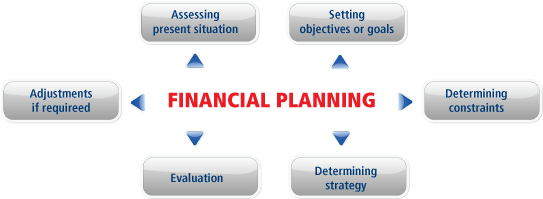
Financial planning is a process consisting of the following activities-
 |
Assessing present assets and resources to understand the current situation |
|
Setting objectives- Both in terms of returns and risks |
|
Determining constraints and financial planning areas like Taxes, Legalities, time horizon, liquidity, unique circumstances |
|
Determining appropriate plan and strategy to achieve financial goals. |
|
Evaluating the plan in a timely manner. |
|
Adjusting and modifying the plan if change in conditions. |
Financial planning is important because it guides and controls the financial decision making process. While making a financial plan objectives and constraints of individual are included so it represents the long term objective of the individual. Planning is a dynamic process so if there is are any changes in an individual's circumstances they can be incorporated into the financial plan.
What
are the broad areas in which financial planning can be undertaken?
A: Financial
planning consists of a variety of things. All these ought to be
planned by individuals keeping in mind their stage in life cycle and their
needs
Financial planning is achieving your financial goals in the most efficient manner. The broad areas of financial planning include -
Financial planning is achieving your financial goals in the most efficient manner. The broad areas of financial planning include -
 |
2. Cash flow planning - In simple terms, cash flow refers to the inflow and outflow of money. It is a record of your income and expenses. Though this sounds simple, very few people actually take time out to find out what comes in and what goes out of their hands each month. Cash flow planning refers to the process of identifying the major expenditures in future (both short-term and long-term) and making planned investments so that the required amount is accumulated within the required time frame. Cash flow planning is the first thing that should be done prior to starting an investment exercise, because only then will you be in a position to know how your finances look like, and what is it that you can invest without causing a strain on yourself. It will also enable you to understand if a particular investment matches with your flow requirement
3. Retirement planning - Retirement planning means making sure you will have enough money to live on after retiring from work. Retirement should be the best period of your life, when you can literally sit back and relax or enjoy your life by reaping benefits of what you earn in so many years of hard work. But it is easier said than done. To achieve a hassle-free retired life, you need to make prudent investment decisions during your working life, thus putting your hard-earned money to work for you in future. Planning for retirement is as important as planning your career and marriage. Life takes its own course and from the poorest to the wealthiest, no one gets spared. We get older every day, without realizing. However, we assume that old age is never going to touch us.
The future depends to a great extent on the choices you make today. Right decisions with the help of proper financial planning, taken at the right time will assure smile and success at the time of retirement. Retirement Planning acquires added importance because of the fact that though longevity has increased, the number of working years haven't.
4. Tax planning - Tax evasion is illegal but tax minimization is legal. Thus you can reduce your tax liability by planning effectively. With proper tax planning you can increase your after tax income.
5. Children future planning- It is essential to plan for the future of your children. The purpose of Children's Future Planning is to create a corpus for foreseeable expenditures such as those on higher education and wedding and to provide for an adequate security cover during their growing years. Savings alone is no longer enough. For ensuring adequate funding of your child's education, you as a parent need to invest appropriate amount systematically and at regular intervals to provide for a financial security to cover any casualties.
6. Insurance planning -Insurance Planning is concerned with ensuring adequate coverage against insurable risks. Calculating the right level of risk cover require considerable expertise. Proper Insurance Planning can help you look at the possibility of getting a wider coverage for the same amount of premium or the same level of coverage for the same amount of premium or the same level of coverage for a reduced premium. Insurance, simply put, is the cover for the risks that we run during our lives. Insurance enables you to live your lives to the fullest, without worrying about the financial impact of events that could hamper it. In other words, insurance protects you from the contingencies. So insurance planning is very important.
7. Estate planning- Every individual acquires a considerable amount of estate during his lifetime which after his death or during his lifetime is transferred to either his heirs or to institutions or to charities. Planning this transfer in the most efficient way is termed as Estate planning.
Who requires financial planning?
A: Almost everyone requires financial planning. As the old adage goes-If one is failing to plan, they are surely planning to fail. Good and thoughtful investment planning is the cornerstone of an individual's good financial health.
Financial planning is about managing your finances to achieve your financial goals in the most optimum manner. It's not about making huge savings or less spending nor does it mean having lots of money for huge making investments. It is about prioritizing your financial goals and achieving them in the most efficient manner to derive maximum utility out of your decisions. So, we can say that everybody requires financial planning as everybody have financial goals and everybody wants to achieve them in the most efficient manner.
Life requires self-generated, goal oriented action - a plan. This extends to every area of your life, including financial. The degree of your planning will determine at least in part the degree to which you are successful. And, although a financial plan does not guarantee success, it is necessary for it (at least in the long-term).
You don't have to be mega rich to have a financial plan. Neither do you have to be very old and approaching retirement. It does not matter how much you earn or what your age is. In fact, your financial situation influences almost every aspect of your lives….from the type of house you live in; to the type of car you drive, to how many vacations you can take. Regular financial planning can help give you peace of mind.
All too often, people delay planning for the future. They may feel such planning should take a back seat to staying financially afloat in the present. However, even those living from paycheck to paycheck can benefit from financial planning by creating a budget. A budget can be used to determine what is actually spent each month and find ways to trim or even eliminate unnecessary or out-of-control expenditures.
The right time to create a financial plan is right now. No matter what your income level or what your hopes for the future, you need a solid plan to achieve your goals. Drifting through life without carefully set goals and well-researched methods of achieving them is a recipe for disaster. To enable your money to offer you more of what you want out of life, start creating a financial plan today.
Financial planning is about managing your finances to achieve your financial goals in the most optimum manner. It's not about making huge savings or less spending nor does it mean having lots of money for huge making investments. It is about prioritizing your financial goals and achieving them in the most efficient manner to derive maximum utility out of your decisions. So, we can say that everybody requires financial planning as everybody have financial goals and everybody wants to achieve them in the most efficient manner.
Life requires self-generated, goal oriented action - a plan. This extends to every area of your life, including financial. The degree of your planning will determine at least in part the degree to which you are successful. And, although a financial plan does not guarantee success, it is necessary for it (at least in the long-term).
You don't have to be mega rich to have a financial plan. Neither do you have to be very old and approaching retirement. It does not matter how much you earn or what your age is. In fact, your financial situation influences almost every aspect of your lives….from the type of house you live in; to the type of car you drive, to how many vacations you can take. Regular financial planning can help give you peace of mind.
All too often, people delay planning for the future. They may feel such planning should take a back seat to staying financially afloat in the present. However, even those living from paycheck to paycheck can benefit from financial planning by creating a budget. A budget can be used to determine what is actually spent each month and find ways to trim or even eliminate unnecessary or out-of-control expenditures.
The right time to create a financial plan is right now. No matter what your income level or what your hopes for the future, you need a solid plan to achieve your goals. Drifting through life without carefully set goals and well-researched methods of achieving them is a recipe for disaster. To enable your money to offer you more of what you want out of life, start creating a financial plan today.
How it is different from wealth management?
A: Although similar fundamentally, Financial planning defers as compared with wealth management.
Wealth management though similar to financial planning is dissimilar in the sense that To do wealth management a considerable amount of wealth is required. Financial planning on the other hand is required by everybody as it deals with planning related to achieve financial goals in the most effective manner.
Any individual go through three Phases in his life -

The Education Phase- In this phase individual's gain knowledge and education but there is no financial wealth at this time so no wealth management is required but even at this time individual have to do financial planning to achieve the utmost of their financial decisions. Financial planning includes decisions regarding how much to save to go to certain college, how much loan can be taken for college fees, how it will be paid etc.
The Accumulation phase- In this phase individuals start working and start accumulating financial wealth and wealth management is required at later stages when wealth is accumulated. Financial planning is required at this stage with decisions relating to how to accumulate financial wealth, how much to spend now and how much to accumulate for future spending etc.
The Retirement phase- In this phase if individuals have accumulated wealth then wealth management is required but if they do not have large financial wealth then it is not required on the other hand financial planning is still required with decisions relating to investment planning (where to invest money) and estate planning ( how to transfer estate).
Thus we can say that Wealth management is required only by the affluent clients but financial planning is required by all at all stages of life and we can also say that in broader term wealth management is also a part of financial planning.
Wealth management though similar to financial planning is dissimilar in the sense that To do wealth management a considerable amount of wealth is required. Financial planning on the other hand is required by everybody as it deals with planning related to achieve financial goals in the most effective manner.
Any individual go through three Phases in his life -
The Education Phase- In this phase individual's gain knowledge and education but there is no financial wealth at this time so no wealth management is required but even at this time individual have to do financial planning to achieve the utmost of their financial decisions. Financial planning includes decisions regarding how much to save to go to certain college, how much loan can be taken for college fees, how it will be paid etc.
The Accumulation phase- In this phase individuals start working and start accumulating financial wealth and wealth management is required at later stages when wealth is accumulated. Financial planning is required at this stage with decisions relating to how to accumulate financial wealth, how much to spend now and how much to accumulate for future spending etc.
The Retirement phase- In this phase if individuals have accumulated wealth then wealth management is required but if they do not have large financial wealth then it is not required on the other hand financial planning is still required with decisions relating to investment planning (where to invest money) and estate planning ( how to transfer estate).
Thus we can say that Wealth management is required only by the affluent clients but financial planning is required by all at all stages of life and we can also say that in broader term wealth management is also a part of financial planning.
Who requires financial planning?
A: Depending upon an individual's needs and wants, a financial plan should include various components. Some things might have precedence over the others, however all things affecting the goals should be covered.
A financial plan should include everything which helps in attainment of your financial goals in the most efficient manner. Though it differs from individual to individual as something important for one individual may not be important for others. But broadly we can say that it should include everything that affects his financial goals.
Financial planning in a broad way should consist of the following activities-
A: Depending upon an individual's needs and wants, a financial plan should include various components. Some things might have precedence over the others, however all things affecting the goals should be covered.
A financial plan should include everything which helps in attainment of your financial goals in the most efficient manner. Though it differs from individual to individual as something important for one individual may not be important for others. But broadly we can say that it should include everything that affects his financial goals.
Financial planning in a broad way should consist of the following activities-
Investment Planning
- Assessing present assets and resources to understand the current situation financial situation - It is the most important thing to do while doing financial planning as this is the starting point utmost care should care should taken while assessing the present situation.
- Setting objectives or goals- Both in terms of returns and risks and long term and short term goals - On the basis of current situation and desired future conditions goals are designed. It should be noted that goals should be realistic and proper prioritization of goals should be done.
- Determining constraints in financial planning areas like Taxes, Legalities, time horizon, liquidity, unique circumstances - While doing planning apart from goals an individual can have constraints like not to invest in non- ethical companies, liquidity constraints etc. so these constraints should be taken into account before designing a plan.
- Determining appropriate plan and strategy to achieve financial goals - After analyzing the goals and constraints various alternative plans are designed and the best plan which achieves the goals in the most efficient manner is chosen.
- Evaluating the plan in a timely manner - It should be noted that financial planning is a dynamic process and not a static one as individual circumstances keeps on changing thus it should be evaluated on timely basis.
- Adjusting and modifying the plan if change in conditions - After evaluating the plan if it required that changes in plan should take place than modifications to plan should be done.
What is Goal setting?
A: It is one of the foremost and
the most important step towards planning finances and investments.
Getting this step correct sets a strong foundation for other activities.
The first and foremost step before starting anything is goal setting or objective setting. The main purpose of goal setting is that it provides direction and purpose to you financial planning. It is important to understand what your goals are and over what time period you want to achieve your goals.
Some goals are short term goals those that you want to achieve within a year while others are long term goals which are for a period of more than one year. Depending on your life stage, expenditure, income, future goals in terms of children education, lifestyle and holidays you can set your goals. Any individual can have many goals but there is always a tradeoff between goals like you can choose between buying a house and providing children's education fees. So while setting goals it is very important to prioritize goals because as explained above there is always a tradeoff between goals and it is dependent on you for what goal you want to provide first. While goal setting it is important to analyze how important the goals are and what the individual will do if goals are not met. An individual goals can be goals relating to buying home, holidays, children education, retirement planning, social goals, goals relating to estate planning etc.
For example:
Mr. Ram a middle class individual with average salary can have the following goals -

The first and foremost step before starting anything is goal setting or objective setting. The main purpose of goal setting is that it provides direction and purpose to you financial planning. It is important to understand what your goals are and over what time period you want to achieve your goals.
Some goals are short term goals those that you want to achieve within a year while others are long term goals which are for a period of more than one year. Depending on your life stage, expenditure, income, future goals in terms of children education, lifestyle and holidays you can set your goals. Any individual can have many goals but there is always a tradeoff between goals like you can choose between buying a house and providing children's education fees. So while setting goals it is very important to prioritize goals because as explained above there is always a tradeoff between goals and it is dependent on you for what goal you want to provide first. While goal setting it is important to analyze how important the goals are and what the individual will do if goals are not met. An individual goals can be goals relating to buying home, holidays, children education, retirement planning, social goals, goals relating to estate planning etc.
For example:
Mr. Ram a middle class individual with average salary can have the following goals -
Why Goal Prioritization is important?
A: How does one decide which goal is more important than the other? Efficient prioritization is the key to good planning.
Setting of goals is important but prioritizing goals is even more important. An individual can have many goals but is important to streamline and prioritize those goals.
For Example:
Mr. Ram who is an average middle class individual has the following goals in his mind

Mr. Ram has not done proper financial planning and has not prioritized his goals. He has provided for his goals in a random manner. But after buying a new car, a new house, having a holiday abroad and providing for children education and parents medication he do not have enough money left to provide for retirement planning and he is regretting the fact that he took lavish holiday abroad and bought a new car. If he had done proper prioritization of goals and had provided for retirement before taking a holiday abroad he would not have been in a situation of regret and his prioritization would have been in the following manner-

So even if Mr. Ram didn't had money after providing for the first four or five goals he would have not regretted because he had made segregation between essential goals and desired goals and meeting essential goals is more important than desired goals.
If you don't prioritize goals then it will be very difficult for you to take the most efficient financial decisions and derive utmost utility from them. Many a times it is seen that investors misspent their income and are in real trouble when it comes to spending on more important goals. Thus prioritization of goals is a very important task. Prioritization is the essential skill you need to have to use the very best use of your own efforts and money. It is particularly important when wealth and income is limited but goals are seemingly unlimited. It helps you to spend your hard earned money wisely, freeing you from less important tasks that can be attended to later or quietly dropped.
Setting of goals is important but prioritizing goals is even more important. An individual can have many goals but is important to streamline and prioritize those goals.
For Example:
Mr. Ram who is an average middle class individual has the following goals in his mind
Mr. Ram has not done proper financial planning and has not prioritized his goals. He has provided for his goals in a random manner. But after buying a new car, a new house, having a holiday abroad and providing for children education and parents medication he do not have enough money left to provide for retirement planning and he is regretting the fact that he took lavish holiday abroad and bought a new car. If he had done proper prioritization of goals and had provided for retirement before taking a holiday abroad he would not have been in a situation of regret and his prioritization would have been in the following manner-
So even if Mr. Ram didn't had money after providing for the first four or five goals he would have not regretted because he had made segregation between essential goals and desired goals and meeting essential goals is more important than desired goals.
If you don't prioritize goals then it will be very difficult for you to take the most efficient financial decisions and derive utmost utility from them. Many a times it is seen that investors misspent their income and are in real trouble when it comes to spending on more important goals. Thus prioritization of goals is a very important task. Prioritization is the essential skill you need to have to use the very best use of your own efforts and money. It is particularly important when wealth and income is limited but goals are seemingly unlimited. It helps you to spend your hard earned money wisely, freeing you from less important tasks that can be attended to later or quietly dropped.
Assessing the current situation.
A: Introspection of one's current situation is the starting point to bridge the gap between present and future.
Before starting any type of financial planning it is important to understand and analyze what is your current situation or where do you stand right now. This helps in understanding what will be your goals with respect to how much wealth you have and how much to accumulate, what insurance you have and how much more less you should have. Financial planning acts as a bridge between your current situation and your future desired situation. To make the best use of this bridge called financial planning it is essential that both its shores- one your current situation and the second your desired future situation should be properly made. The whole process of financial planning is based on what your goals in future are and assessing the current situation properly helps in defining future goals in the most optimum manner. Thus it is an essential part of financial planning.
Mr. Ram is an average middle class person with an average or modest salary which is just a little bit more than his expenses. Mr. Ram has done financial planning by planning what will be his goals in future but has not assessed his present situation correctly. Mr. Ram is in earlier fifties but due to his goals requiring large sum of money most of his investments are in risky equities for higher returns. But his current situation that is high age, not very large income does not allow him to take that risk and most of his investments should be in fixed income securities. Due to his not assessing the current situation correctly in spite of doing financial planning he may not be able to achieve his goals effectively.

If Mr. Ram would have assessed his present situation in the way as shown above he would have analyzed his risk properly and would have reaped better results out of financial planning.
Before starting any type of financial planning it is important to understand and analyze what is your current situation or where do you stand right now. This helps in understanding what will be your goals with respect to how much wealth you have and how much to accumulate, what insurance you have and how much more less you should have. Financial planning acts as a bridge between your current situation and your future desired situation. To make the best use of this bridge called financial planning it is essential that both its shores- one your current situation and the second your desired future situation should be properly made. The whole process of financial planning is based on what your goals in future are and assessing the current situation properly helps in defining future goals in the most optimum manner. Thus it is an essential part of financial planning.
Mr. Ram is an average middle class person with an average or modest salary which is just a little bit more than his expenses. Mr. Ram has done financial planning by planning what will be his goals in future but has not assessed his present situation correctly. Mr. Ram is in earlier fifties but due to his goals requiring large sum of money most of his investments are in risky equities for higher returns. But his current situation that is high age, not very large income does not allow him to take that risk and most of his investments should be in fixed income securities. Due to his not assessing the current situation correctly in spite of doing financial planning he may not be able to achieve his goals effectively.
If Mr. Ram would have assessed his present situation in the way as shown above he would have analyzed his risk properly and would have reaped better results out of financial planning.
- Here you can find appropriate Excel Sheet for manage Financial everything.


 What is investing?